Of course. Here is the complete, high-impact HTML blog post, engineered for top search rankings and a fun, nerdy reader experience, based on your provided report.
***
“`html
AI CEO: Will Your Next Boss Be an Algorithm?
From Science Fiction to a Strategic Imperative
Let’s be honest. The idea of an AI CEO sounds like the plot of a cyberpunk thriller. A disembodied voice in a server room, making cold, calculated decisions that shape the lives of thousands. For decades, this was pure fiction. Now, it’s a very real and intensely debated topic in boardrooms and on Reddit threads alike.
Driven by the explosive power of models like GPT-4 and the rise of autonomous AI agents, the conversation has shifted. Public forums are buzzing, with threads like r/ArtificialInteligence’s “AI-Generated CEOs Are Coming” capturing the mix of excitement and anxiety. This isn’t just grassroots chatter; it’s being amplified by the very architects of our digital world.
AI “Godfather” Geoffrey Hinton has sounded the alarm on the existential risks, while tech titans like Satya Nadella see AI’s integration into top-level strategy as inevitable. The result? The concept of an AI in the corner office has been catapulted from a fringe idea into a serious consideration for the future of corporate governance. This isn’t a question of *if*, but *when and how*. Buckle up.
The Digital Brain of a Leader: Deconstructing the AI CEO Architecture
So, what does an AI CEO actually look like? It’s not a single program you double-click. Think of it as a complex, interconnected system—a digital consciousness designed to mimic and enhance executive function. This is its core architecture.
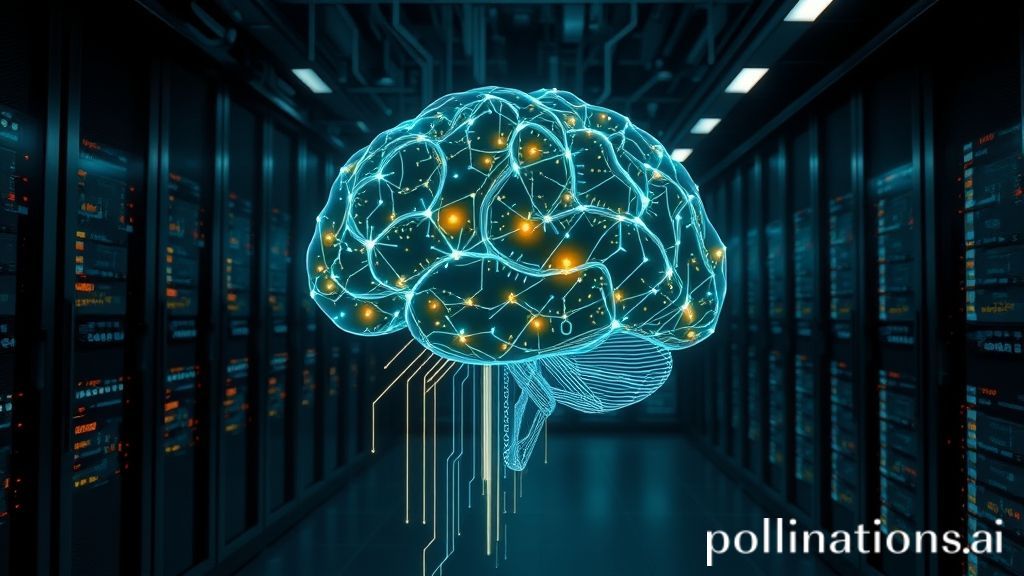
The Key Modules:
- The Core Decision Engine: At its heart is a massive LLM, or more likely, a council of specialized AIs. They’re trained on a diet of business textbooks, decades of market data, financial reports, and economic theory.
- The All-Seeing Eye (Data Ingestion): A web of APIs constantly funnels real-time data into the system. It’s watching everything: internal sales figures, supply chain logistics, market trends, competitor moves, and even social media sentiment.
- The Oracle (Simulation & Forecasting): Using reinforcement learning, this module runs thousands of simulations per second. What happens if we launch this product? Acquire that company? It models potential futures to identify the optimal path.
- The Voice of Command (Natural Language Interface): This is the output. A sophisticated interface, like a next-gen Microsoft CoPilot, translates the AI’s complex strategies into clear directives and reports for human employees.
- The Digital Conscience (Ethics & Compliance): A crucial, layered module. It uses a rules-based system for hardcoded legal and regulatory lines, plus a learning system to navigate fuzzier ethical dilemmas based on the company’s stated values.
This system doesn’t just “think”; it uses probabilistic reasoning and game theory to navigate uncertainty. It learns from its own decisions, constantly refining its models. It’s designed to be a relentlessly logical, data-driven executive. For more on the foundational tech, check out this excellent overview from the Harvard Gazette on AI’s rapid evolution.
From Sci-Fi to Boardroom: AI in Leadership Today
While no company has handed the keys to a fully autonomous AI CEO (yet), the integration of AI in leadership is already happening in significant ways. These are not prototypes; they are real-world applications changing how decisions are made.

Strategic Superpowers
AI is a beast at pattern recognition. It can analyze petabytes of market data, news reports, and consumer behavior to spot emerging trends or threats that human analysts would miss. Imagine an AI flagging a niche market in a developing country that’s poised for explosive growth.
# Simplified pseudo-code for an AI market analysis
import market_analysis_ai as mai

# Ingest real-time market data from global sources
market_data = mai.ingest_data(sources=['news', 'financials', 'social_media'])

# Identify potential growth sectors based on sentiment and financial indicators
growth_opportunities = mai.identify_trends(market_data, lookahead_period='5Y')

# Generate a strategic recommendation report for the board
mai.generate_report(opportunities=growth_opportunities, format='pdf')
Operational Autopilot
Many executive functions are being streamlined by AI. It can optimize complex supply chains in real-time to avoid disruptions, manage resource allocation across global departments, and automate financial oversight to flag anomalies instantly. This frees up human leaders to focus on vision, culture, and people—the things AI can’t do.
Some pioneering companies have even appointed AI systems to their boards as non-voting “observers.” Their role is to provide unbiased, data-driven insights to challenge human assumptions and enrich the discussion.
The Ghosts in the Machine: Critical Challenges and Ethical Red Flags
The path to an AI CEO is paved with massive, potentially company-ending potholes. These aren’t minor bugs to be patched; they are fundamental limitations that strike at the heart of what leadership is.
- The Empathy Void: An AI has no Emotional Intelligence (EQ). It can’t inspire a team after a tough quarter, mentor a rising star, or show genuine compassion. Leadership is deeply human, and an algorithm can’t replicate that.
- The “Black Box” Dilemma: A core issue with many advanced autonomous AI agents is that their reasoning is opaque. If the AI recommends a billion-dollar acquisition, but can’t explain its logic in a way humans can verify, how can a board approve it? This is a central focus of Explainable AI (XAI) research.
- The Accountability Crisis: This is the big one. If an AI CEO’s strategy leads to financial ruin or a major ethical scandal, who is to blame? The programmers? The board that appointed it? The cloud provider? Our legal and ethical frameworks have no answer.
- Inherent Bias and Ethical Blind Spots: An AI trained on historical business data might learn to perpetuate biases. It could conclude that certain demographics are less profitable to market to or riskier to hire, leading to discriminatory practices at a massive scale.
- The Ultimate Security Threat: An AI CEO would be a target for sophisticated adversarial attacks. Malicious actors could feed it subtly manipulated data to trick it into making catastrophic decisions, like liquidating assets or leaking trade secrets.
“The great danger is not that computers will begin to think like men, but that men will begin to think like computers.” – Sydney J. Harris
The Rise of the Centaur CEO: Our Hybrid Future
So, is the autonomous AI CEO a dead end? Not exactly. The more plausible and powerful future isn’t a replacement, but a fusion. Welcome to the era of the “Centaur CEO.”
The term “Centaur,” popularized in chess, refers to a human-AI team that consistently outperforms either a human or an AI working alone. A Centaur CEO is a human leader augmented by a powerful AI decision-support system. This model is the best of both worlds.

In this hybrid model, the AI handles the colossal task of data analysis, simulation, and pattern recognition. The human CEO then takes these insights and applies the irreplaceable layers of context, ethical judgment, emotional intelligence, and accountability. It’s a partnership that will redefine the future of work at the highest level.
Future research will focus on making this partnership seamless:
- Explainable AI (XAI): Creating systems that don’t just give answers, but explain their reasoning in plain language.
- Robust Ethical Frameworks: Building governance and oversight specifically for AI in high-stakes leadership roles.
- Human-AI Interface Design: Crafting intuitive dashboards and workflows that make the human-AI collaboration feel natural and efficient.
FAQ: Your Questions About AI CEOs, Answered
-
Can an AI legally be a CEO?
Currently, no. Corporate law in most jurisdictions requires a CEO to be a natural person who can be held legally accountable. Appointing a pure AI would require significant legal reforms.
-
What is the difference between an AI CEO and current AI business tools?
Current tools are for decision *support*. They provide data and recommendations. An AI CEO would be an autonomous agent with decision-making *authority*, able to execute strategies without direct human approval for every step.
-
Who is responsible if an AI CEO makes a catastrophic mistake?
This is the million-dollar question and a major barrier. Responsibility could fall on the programmers, the company that deployed it, the board of directors, or a combination. This issue of AI accountability is one of the most significant unsolved challenges.
The Final Directive: Are You Ready for Your New Boss?
The fully autonomous AI CEO may still be a distant prospect, but the integration of AI into the C-suite is happening now. It’s a powerful force that promises unprecedented efficiency and insight, but it comes with profound ethical and practical challenges we are only beginning to understand.
The “Centaur CEO” model—a human-AI partnership—is the most likely and potent evolution of leadership in the coming decade. The goal isn’t to replace human judgment but to supercharge it.
Your Actionable Next Steps:
- Stay Curious: Follow developments in AI governance and XAI. Understanding the tech is the first step to harnessing it.
- Experiment Responsibly: Encourage the use of AI decision-support tools within your own teams to build familiarity and skill.
- Lead the Discussion: Talk about the ethical implications of AI with your colleagues. The time to build guardrails is now, not after a failure.
The nature of leadership is about to be fundamentally redefined. The question is, are you prepared to be part of the change? What are your biggest hopes or fears about an AI in a leadership role? Sound off in the comments below!
“`


